

Most electric outboard brands lock you into their own batteries. ePropulsion doesn't. The company publishes the specs a third-party pack has to meet and leaves the choice to you, which is worth something, because 48V LiFePO4 packs built for golf carts and solar storage have gotten cheap. The gap between one of those and a purpose-built marine battery can run into thousands of dollars.
The catch is that nobody checks your homework. An electric outboard pulls heavy current for hours at a stretch, and a battery that carries the load on paper doesn't always carry it on the water. We've heard from enough owners with a motor that quits at full throttle to know how these stories tend to start. So before you spend anything, here's what the numbers mean and how to wire the thing properly.
The Short Answer
Yes – on the 48V motors. The Spirit 1.0 Plus, Spirit 1.0 Evo, Navy 3.0 Evo, Navy 6.0 Evo and the Pod Drive Evo series will all run on a third-party lead-acid or lithium battery, provided the pack meets ePropulsion's published specs. The 96V systems are a different animal. X Series outboards, I Series inboards and the Pod Drive ESSA are designed around ePropulsion's own battery architecture and get installed by certified technicians; putting a third-party pack on one of those isn't a realistic conversation.
Two caveats before we get into numbers. Hydrogeneration won't work without an ePropulsion battery, and the warranty math changes. More on both further down.
The Specs Your Battery Must Meet
Start with continuous discharge current – the current a battery can put out for a long stretch without overheating or tripping its own protection. Battery marketing loves peak numbers. You'll see "350A" printed large on a pack that can only hold it for a second or two, and for an outboard the peak figure is nearly useless. What matters is what the battery sustains at full throttle, hour after hour.
The requirements themselves come straight from the motor's power draw. A Navy 3.0 Evo pulls up to 3,000 W, a Navy 6.0 Evo up to 6,000 W. Divide by 48 volts and you get 62.5A and 125A. That's the continuous current your battery has to hold, ideally with some headroom on top.
| Specification | Requirement |
|---|---|
| Chemistry | Lead-acid or lithium (LiFePO4 recommended) |
| Rated voltage | 48V nominal |
| Minimum voltage | 39V |
| Maximum voltage | 60V |
| Continuous discharge current | 62.5A or higher (Navy 3.0 Evo, Pod Drive 3.0 Evo) / 125A or higher (Navy 6.0 Evo, Pod Drive 6.0 Evo) |
| Capacity for about one hour at full throttle | 3,000 Wh (Navy 3.0 Evo) / 6,000 Wh (Navy 6.0 Evo) |
A single 48V pack keeps things simple, but series wiring works too – four 12V batteries or two 24V batteries adding up to 48V. Just remember that every battery in the string carries the full current, so each one has to meet its own discharge spec. The weakest battery sets the ceiling for the whole bank.
What Goes Wrong When the Battery Falls Short
We'd love to tell you an underspecced battery simply performs a bit worse. It doesn't work that way.
The first thing you'll meet is voltage sag. Push a battery near its discharge limit and its output voltage drops. Drop far enough, and the motor's low-voltage protection kicks in – the motor just stops. Fifty metres from the launch on a calm day, that's an annoyance. Out on open water with the wind picking up, it's something else entirely.
Then there's the protection circuitry inside the battery itself. A BMS that sees too much current cuts output, waits, then switches back on. The motor ends up fed by a supply that stutters – on, off, on again – and repeated interruptions at high amperage are exactly the kind of abuse that kills a motor's control electronics. This is how a battery bought to save money turns into a motor repair bill.
Heat works slower. Cells running at or past their limit get hot; hot cells degrade, and a pack that has been cooked a few times loses capacity for good.
One thing worth knowing about all of this. The wrong battery rarely fails on day one. It does half throttle fine. It might even manage a few short bursts at full power. Then comes the first long run, loaded, flat out, and that's when it lets go.
Where the Warranty Stands
There's more nuance here than the forum threads suggest. Bolting on a third-party battery does not, by itself, kill your motor's warranty. What ePropulsion's terms exclude is a malfunction caused by that battery. A defect that has nothing to do with the power source stays covered; damage traced back to voltage sag, current cycling, or a bad connection doesn't.
In practice, that shifts the burden of proof onto you. Buy an ePropulsion pack and compatibility is the manufacturer's problem. Buy third-party, and it's yours. Keep the battery's spec sheet – if a claim ever comes up, the document showing your pack met every requirement is the one you'll want in hand.
What You Give Up Without the ePropulsion Battery
The specs get a third-party pack running. What they can't reproduce is the conversation between an ePropulsion battery and an ePropulsion motor.
Genuine E-Series batteries, such as the ePropulsion E60 and E163, connect to the motor via a dedicated communication cable, and over that link the motor sees what's happening inside the pack: charge level, voltage, current draw, and temperature. The display on the tiller shows a range estimate you can trust, and the motor adjusts to the battery's condition, easing off when the pack runs hot, refusing to drag the charge down to a damaging level. ePropulsion calls this its operation strategy. It exists only when both ends of the cable use the same protocol.
Take the cable out of the equation, and the motor runs blind. Set the throttle up correctly (see below), and you'll get a workable approximation on the display, but it won't ever match real battery data.
Hydrogeneration goes away too. The Spirit 1.0 Evo and Navy Evo motors can recharge a battery while a sailboat is under sail – with an ePropulsion battery only.
Some third-party makers patch the data gap with Bluetooth and a phone app: power draw, remaining capacity, and an estimated range worked out from the phone's GPS. It covers a fair share of what the communication cable does, though now your phone has to stay within reach. The cheaper packs give you an LED gauge on the case and call it a day.
How to Connect a Third-Party Battery
E-Series batteries use ePropulsion's quick-connect terminals. Nearly every third-party pack uses threaded studs and ring terminals instead, so something has to bridge the gap between them.
The blunt option is to cut off the quick-connect terminals on the motor's power cable and crimp on ring terminals. It works. But up to 125A runs through those crimps; a marginal crimp at that current is a genuine hazard, and damage traced to a bad connection lands outside warranty coverage on its own merits. If you take this route, pay a professional to crimp.
The ePropulsion Third Party Battery Kit is the tidier option – battery output cables plus a 150A bus bar. Motor cables connect to the bus bar; an output cable runs from the bus bar to the battery's ring terminals; the factory quick-disconnect remains intact; and nothing gets cut.
Configure the Throttle Before the First Run
An ePropulsion battery introduces itself to the motor over the communication cable. A third-party pack stays silent, so the introduction is on you: program the tiller or remote throttle with the battery's chemistry, capacity, and cutoff voltage before the first run. Owners skip this step all the time, and the result is a motor making low-voltage decisions based on a battery it isn't connected to – shutting down with charge still in the pack, or draining it deeper than the chemistry can take.
Choosing the Pack Itself
Here's a pattern you'll notice quickly while shopping. Most 48V lithium packs with a genuinely high continuous rating were built for electric golf carts, which makes sense – a golf cart, like an outboard, spends its life pulling heavy current for long stretches. Two things still separate a golf cart battery from a marine one, and neither shows up in the headline numbers.
Sealing is the first. A golf cart never takes spray or a wave over the transom, so plenty of these packs ship with no meaningful IP rating. That's not automatically a dealbreaker – it just decides where the battery can live. Low in an open hull where bilge water sloshes around, an unsealed pack is on borrowed time. Up in a dry, ventilated compartment, it can run for years without complaint.
The second is the BMS, the battery management system. Every lithium pack has one, and in a high-capacity battery it's arguably the most safety-critical part inside the case. It's also the part budget brands quietly cheap out on. Two packs with identical voltage and capacity on the label can carry wildly different protection electronics, and you only find out which one you bought when things get stressful. Marine-focused brands – Epoch, among the ones we carry – publish their BMS specs in full. A listing that says nothing about its BMS is saying something.
On paper, lead-acid qualifies too, and the spec table above allows it. On the water, weight settles the argument. A 48V lithium pack in the 4,800 Wh class comes in around 44 kg (97 lb); building the same capacity out of lead-acid means roughly three times that weight, and you can't even use all of it, since lead-acid doesn't tolerate deep discharge the way LiFePO4 does. A small boat feels every one of those kilograms.
Example Install With a Navy 6.0 Evo and Epoch Batteries
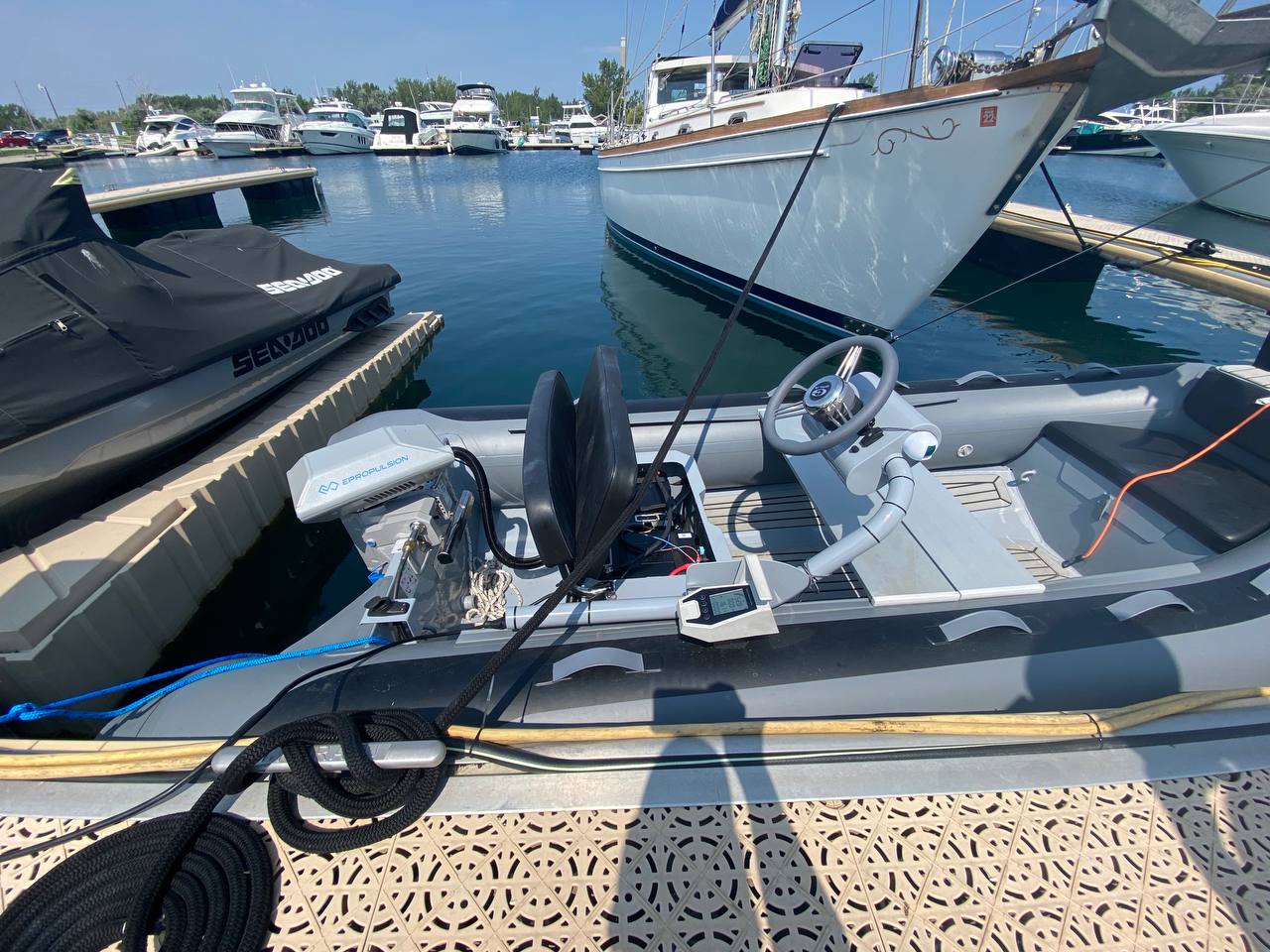
Here is the spec table above applied to a boat we fitted out: a GALA Atlantis A360Q, a 3.6 m (11 ft 10 in) RIB with a 2.5 mm aluminum hull, running an ePropulsion Navy 6.0 Evo from a third-party bank of Epoch LiFePO4 batteries.
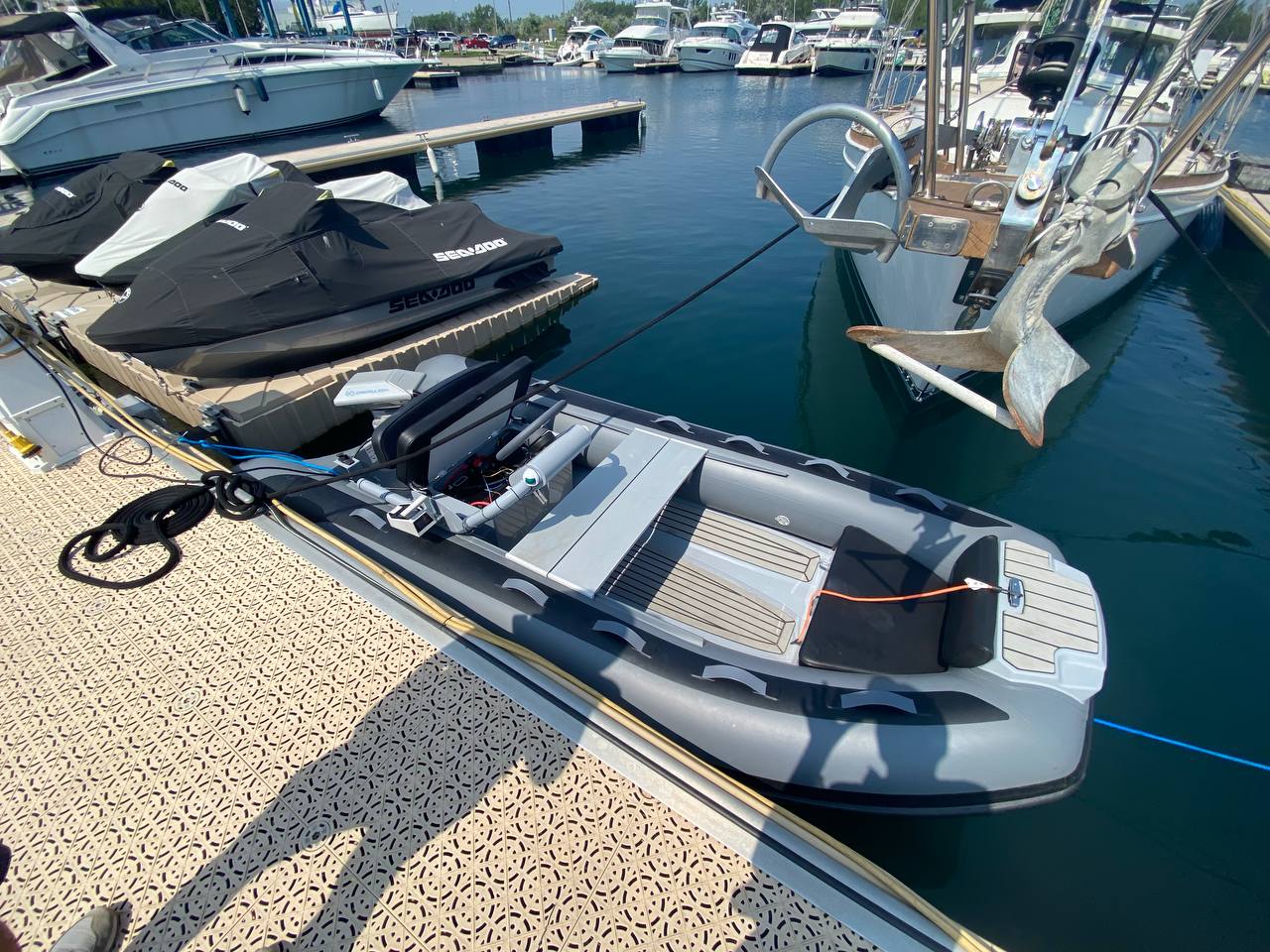
The motor sets the requirement. At 6 kW and 48V, the Navy 6.0 Evo can draw 125A, and whatever sits in the console has to hold that continuously. Check the rating per pack: a single Epoch 48V 50Ah marine battery is rated for 100A continuous, so on this motor it needs a second one in parallel, which brings the bank to 200A, 100Ah and about 5,100 Wh.
Both packs sit inside the side console, up off the hull floor. Epoch rates its marine batteries IP67, so spray wouldn't stop them, but the console keeps them clear of the water that collects in the hull, which is the placement rule from the section above.
Walkaround of the console: the Epoch battery bay, the remote throttle with its display, and the Navy 6.0 Evo on the transom.
On a RIB that never sails, losing hydrogeneration costs nothing, since it only charges under sail. What this setup gives up is battery data. With no ePropulsion communication cable in the system, the remote's display works from the chemistry, capacity and cutoff voltage programmed into the throttle at install, and it has no live readings from the pack. Epoch's Bluetooth app covers part of that gap, showing charge, current and temperature for each pack on a phone.
Hull dimensions, the five-person Canadian capacity rating and the full parts list are on the project page for this RIB with an ePropulsion Navy 6.0 Evo.
Where That Leaves You
None of this should put you off. ePropulsion's openness to third-party batteries is a real advantage, and plenty of boaters run these setups season after season without a hiccup. What the successful ones have in common is boring: they took the continuous rating seriously and wired the connection once, properly.
If matching specs isn't how you want to spend an evening, the packs in Batteries for ePropulsion Motors already speak the motor's language, communication cable and all. If you're set on going third-party, our 48V Batteries collection carries marine-grade options, and we're happy to look over any spec sheet against your motor before money changes hands. And if the motor itself is still an open question, the full ePropulsion Outboards range is the place to start.
FAQ
Will a third-party battery void my ePropulsion warranty?
Not by itself. The warranty still covers defects unrelated to the power source. What's excluded is a malfunction the third-party battery caused – voltage sag damage, current cycling, a bad connection, that family of problems.
Does hydrogeneration work with a third-party battery?
No. Hydrogeneration on the Spirit 1.0 Evo and Navy Evo motors requires a communication link between the motor and the battery, and that link only exists with a genuine ePropulsion pack.
What continuous discharge current does my motor need?
From a 48V pack: 62.5A or higher for the Navy 3.0 Evo and Pod Drive 3.0 Evo, 125A or higher for the Navy 6.0 Evo and Pod Drive 6.0 Evo. And judge batteries on the continuous rating – the peak figure tells you very little.
Can I use a golf cart battery with an ePropulsion outboard?
It can work, as long as the voltage and continuous discharge numbers check out. What golf cart packs usually lack is a marine IP rating, so keep the battery somewhere spray and bilge water can't find it.
Can the Spirit 1.0 Plus run on an external third-party battery?
Yes. You'll need an external battery power cable and a 48V pack that meets spec. A common setup runs the external battery for range and keeps the standard Spirit battery aboard as a reserve.